Showing posts with label Canada. Show all posts

Legacy FamilyTree Webinars (MyHeritage) announce French sessions

You may or may not have received an email from MyHeritage announcing their launch of a French-language Webinar Series.

Daniel Horowitz stated:
"Starting October 7, a new series of live genealogy webinars will be offered entirely in French, alongside more than 100 French-language sessions now available on demand.

"This is an exciting addition for French-speaking genealogists worldwide, and a great resource to share with anyone in your community who speaks French or researches in French-language records."

Why is this exciting for me?
During the summer, I received an email from Geoff at Legacy Webinars telling me about this French launch. Then more exciting, he asked me if they could add one of my sessions to this new library! Of course I said, yes! 

The link to my session filles du roi aux meres dune nation in French is below. You need a Legacy Webinar account to watch and obtain handout.  
The handout has also been translated into French. 

My original session Daughters of the King to Mothers of a Nation in English is at:

How does this benefit you?
The first three live sessions (all free to attend) are:
Filae : la maison des archives originales françaises with Yann Guillerm, Community Manager and Editor at Filae, Tuesday, October 7, 2025 at 2 P.M. GMT / 10 A.M. EST
Explorer vos racines en France : méthodes et ressources en ligne avec les collections de MyHeritage with Marie Cappart, historian and professional genealogist, Tuesday, October 21, 2025 at 2 P.M. GMT / 10 A.M. EST
Explorer vos racines au Luxembourg : archives locales et ressources MyHeritage with Liliane Hierro, professional genealogist and author, Tuesday, November 4, 2025 at 2 P.M. GMT / 10 A.M. EST

Halloween in Canada

Many genealogical speakers have a mascot. I researched what mascot would represent Canada and my history. I picked a female Polar Bear. I then had to come up with a name. Hudson's Bay Company started in 1670 so it has been around for a long time of Canada's history. One of my daughter's came up with the name "Hudson Bear". I loved it. 

Hudson's Bear has produced her first video Halloween in Canada. In this short video, she explains three different topics related to Halloween. 

The 4minutes video is on my YouTube channel. The link is  https://youtu.be/oYrhkHxR35I

The video discusses three items. 

  1. How Halloween came to Canada.
  2. Where the phrase "Trick or Treat" was first published
  3. Halloween in Churchill, Manitoba. 
Halloween in Churchill is my favourite since Churchill is the Polar Bear capital of the world and this part involves Polar Bears. 


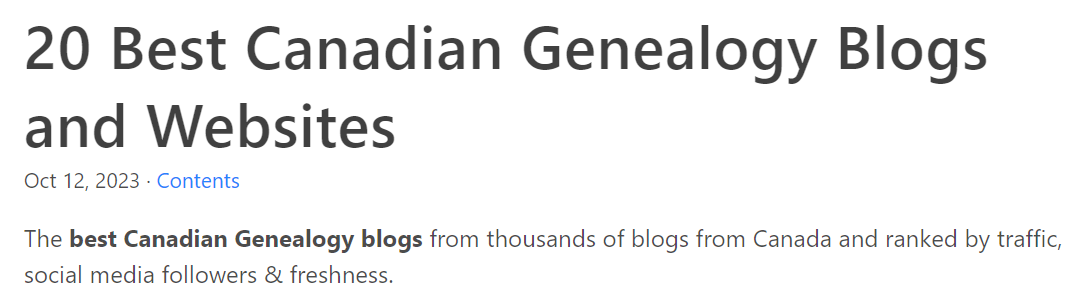
20 Best Canadian Genealogy Blogs and Websites

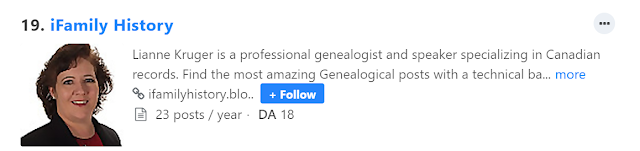
I received an email from Anuj, the Founder of Feedspot. They congratulated me on being selected by their panelists as one of the Top 20 Canadian Genealogy Blogs on the web. I was stunned, amazed, amused, and also honoured to be included with the others.
I am honoured to be placed as number 19 on this list.
19 iFamilyHistory
I didn't post this to brag but to share with you the link of the article so you will go check out the list. I also wanted to share the group that put this article together. 


Link to blog:    20 Best Canadian Genealogy Blogs and Websites.

Number one is Gail! If you are unfamiliar with her blog, you will enjoy the vast information on her blog. She posts almost everyday. Her main content is Canadian genealogy but she blogs about genealogy news all over the world. 

A few other friends' blogs made it on the list, along with some blogs I am unfamiliar with, though not for long! And thank you for this list of new reading material, Feedspot! 

Enjoy! 


What did Canada do during the American Civil War of 1861-1865

The online Canadian Encyclopedia has a great article identifying Canada's involvement in the US Civil War of 1861-1865. This is a summary of that article. The link to the full article is at the bottom of this post. 

The war occurred just before Canada was Canada as a country. At the time of the Civil War there was the Province of Canada which consisted of Canada West, (later Ontario), Canada East (later Quebec) and the Maritimes Colonies: Nova Scotia, New Brunswick, Prince Edward Island and Newfoundland. These four are now known as Atlantic Canada. Canada East and Canada West were the . When the article refers to Canada it is referring to Canada East and Canada West. When the article refers to Maritimes it is referring to the four maritime colonies. 

You probably have heard of the Underground Railroad which was set up to help slaves from the south come to Canada to be able to live free without worrying about being caught. This had been going on for many years before the war. This didn't make southern United States happy. 

The newspapers in Canada and the Maritimes favoured the south during this conflict because it was a little "guy" standing up to a big "guy" who wasn't protecting its interests. Canada and the Maritimes felt that way with Britain and were discussing becoming its own country. Many felt being a country would help prevent the U.S. Manifest Destiny of owning all of North America. Canadians were worried about being forced to be American. 

About 40,000 Canadians and Maritimers fought in the war but most of them fought for the Union (North) not the Confederates (South). Many Canadians had businesses in northern United States that they were most likely protecting. 

"Canadian and Maritime soldiers and sailors fought in nearly every battle of the American Civil War. By the war's end, many had become officers and 29 had won the Congressional Medal of Honor, the highest military honour in the United States." 

During the war, there were also cross border conflicts. The Trent Affair, Chesapeake Affair, St Albans Raid as well as Confederate President Jefferson Davis sending troops to Canada to fight the North from the north. 

If you have Irish ancestors then you may have heard of the Fenians. The Brotherhood was started in United States in 1858 and were very active fighting in the U.S. and Ireland for Irish freedom from Britain. They came to Canada in 1866 in an attempt to "take Canada hostage and trade it for Ireland's independence from Britain." Their riots inflicted much damage. This makes me laugh knowing how big Canada was even back then but it helped convince Canadians to form the Confederation because it proved that U.S. was a threat. July 1st 1867 Ontario, Quebec, Nova Scotia and New Brunswick formed Canada. 

Many Americans were upset with Canadians because of their role in the civil war and that many Confederate generals and President Davis fled to the Province of Canada after the war. Britain helped the Confederacy and when they lost the war, negotiations of compensation began between Britain and United States. One idea discussed was giving U.S. a part of Canada as Britain's payment. The Treaty of Washington in 1871 stopped this idea. Instead, Britain, paid Canada for the much damage caused by the Fenian raids done by Americans. In this way, this "was the last battle of the American Civil War and an early recognition of Canada's independence." 

Notable Canadians 
In September 1831, Caliza Lavallee, who composed the music for "O Canada", enlisted in the Union Army.

Edward P Doherty, led the detachment that found and killed Lincoln's assassin, John Wilkes Booth. 

Anderson Abbot was the first Canadian born Black person to graduate from medical school. He was a civilian surgeon for the Union Army in Washington, D.C.

This is my favourite. Sarah Edmonds, shown on the right, disguised herself as a man to serve as a male nurse in the Union Army. Her autobiography Nurse and Spy in the Union Army, states she conducted numerous spy missions behind the Confederate line. She went by the name Franklin Thompson. 

Do you have any Canadian ancestors who fought in the American Civil War? 


Article Source 
www.thecanadianencyclopedia.ca/en/article/american-civil-war 


More resources

FamilySearch: Canadians in the U.S. Civil War

Wikipedia: Canada and the American Civil War

Library and Archives Canada: Influence of the American Civil War

Ontario Government: Documents from the Front: The American Civil War and Fenian Raids in the 1860s


Photo source: Wikipedia, en.wikipedia.org/wiki/Sarah_Emma_Edmonds 


Ancestry: Canada, South African War Land Grants, 1908-1910

The first time Canada sent troops overseas to fight a war was the Boer War (also known as the Second Boer War or South African War). Some may say this is the second war and therefore I have a note about Mahdist War is below.  

During the Boer War (1899-1902), about 7,300 Canadian troops and 12 Nursing Sisters (nurses) served in South Africa. In 1908 the Bounty Land Acts gave Canadian veterans 320 acres of Dominion Land in South Africa or a payment of $160 in scrip.   

Ancestry has a database of the application forms at 
https://www.ancestry.ca/search/collections/9150/

This database contains applications for these bounty land grants. Applications typically includes the following details:

  • name
  • regiment
  • service start date, location
  • end date of service
  • residence at time of application
  • death date and location are listed only for those whose relatives who are applying as a beneficiary of the bounty. 

There are two pages for most applications therefore click the right arrow to see the second page. If you want to save the document, save both pages individually. It does not automatically save both pages.

The majority of the war veterans had returned home to Canada. The applications came from all provinces and two territories. The application was done in 1908 so all western provinces were now part of Canada. No one was from what is known today as Nunavut. 

Of the applications not living in Canada, 295 were living in South Africa. Other countries these veterans were living in include England, Fiji, Germany, Ireland, Italy, Scotland, a few different states in United States and Wales.
At least one of the twelve Nursing Sisters applied for the bounty.

A few applications were requested for family members when the soldier had died. A father applied for his son and the battle his son died in is listed. A few widows apply because their husband had died. Date of death is given as proof. A sister applied but her brother's death date or information is not given. 


Note about Boer War being the first war Canada went overseas to fight. 
Canada participated in the Mahdist War as a Belligerent and may be considered the first overseas participation as a nation.

"On January 26th, 1885 a British relief force of over 5,000 soldiers which had struggled its way up the Nile from Cairo, spotted their objective, Khartoum, with them were dozens of Canadians who had brought the British boats upriver. "The Canadian boatmen were known as the “Nile Voyageurs”. The first group of Canadians in the young country’s history, to participate in military action overseas. "Because they were civilians contracted by the British military, with the consent of the Canadian government, and did not wear uniforms, it is actually more correct to say it was Canada’s first participation as a part of a British military expedition abroad."

Source: 
https://www.rcinet.ca/en/2015/01/26/canadas-first-military-mission-overseas/ 
For more information also see https://en.wikipedia.org/wiki/Mahdist_War

"Voyagers" was the name of the (mostly) French Canadians who transported furs by canoe in the fur trading years for companies such as the Hudson's Bay Company.